At any point in time devices are electrified if higher power or digital connectivity increases. This heat generated increases greatly which can limit the product’s lifespan. Here we introduce the notion of optimizing the temperature for generating heat.
You will learn the basic principles of thermal management and the common ways in which electronics are cooled. We will also show some common ways on heat transfer and cooling for electrical components and other items using thermal management techniques.
THERMAL MANAGEMENT CONCEPT
There are three modes of transmitting temperature of electricity: conduction, convection or radiation. All three methods are used in cooling electronics and their implementation and effectiveness may not always be the same in all applications. Thermal simulations give engineers visual evidence of temperature and air flow inside machines and systems. Most thermal simulation software relies on Computational Fluid Dynamics techniques and simulations can predict the temperatures and flows of an electronic system. Thermal simulations help engineers design and develop the cooling system.
THERMAL RESISTANCE OF DEVICES
The thermal resistance measured from the junction to the case of a semiconductor device is typically expressed. For example a heat system that is rated for 10°c/W has 10°C hotter than the nearby air when it dissipates 1 Watt of power. A lower junction resistance to surrounding resistance indicates a more efficient device. When comparing two devices with different die free packaging thermal properties their junction to. Case resistances can be lowered in these cases. A direct correlation between the comparative efficacity. Some of the semiconductor packages have different orientation dies and different die. Various angles and shapes in different copper and other metals.
HEAT PIPES
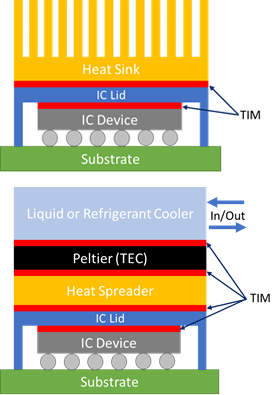
A heat pipe of any kind is a heat-transferring device that utilizes evaporation and condensation of a two – phase cooling fluid or coolant to convey large amounts of heat. A typical heat pipe is formed from a transparent hollow tube made from a conductive steel material such as copper or aluminum. The advantage of heat pipes is their very efficient transmission of heat energy. Copper is used if heat pipes must operate below the freezing point in water, and aluminum heat piping is used for electronic cooling in space. The most common heat pipe for electrical thermal management is a copper envelope and coil with water as the working fluid.
APPLICATIONS FOR HEAT PIPES
Heat pipes effectively transfer heat from heat sources and energy-sensitive components to a fixed array or a heat sink located elsewhere. They are typically integrated into a thermal management subsystem to move heat away from the source to more distant regions. Hundreds of watts of power can be dissipated using a forced air convection technique. The highly efficient, high-performance power electronics cooler is one type of heat management solution ideal for environments where space is limited for a traditional cooling system. A hot swath is positioned near the heat source, and heat pipelines transfer the thermal energy across fins. This setup utilizes convection to efficiently dissipate heat.
HEAT SINKS
Heat sinks are generally used in electronic products and are now fundamental for modern electronics. A heat sink usually consists of a metal building with one or more flat surfaces to ensure good thermal contact with the components to be cooled. Heat Sink is often installed in conjunction with fans to increase the flow rate of air through the heat sink. This is more effective since the heat will be replaced faster than convection would. This referred to as forced air. Heat sinks have become nearly crucial to embedded circuits like microprocessors and power absorbing chips like DSPs, GPUs and others. Heat sinks function by efficiently switching heat energy from an object at high temperature to another object at low temperature of better heat capacity. This rapid transfer of thermal energy brings the first object into thermal equilibrium with the second which lowers the temperature of the first. The more common design of a heat sink is a metallic device that has many fins. The high heat conductivity of the metal with the wide surface area result in an efficient transfer. This cools the heat sink and any object which the thermal heat contact with. There is also use of fluids to cool air or heating electronics for some applications.
HEAT SINKS PERFORMANCE
Forced convection heat sink thermal performance is increased by increasing the thermal conductivity of the heat sink materials through the large surface area (usually extending edges, such as fins or foam metal) and increasing the overall. CFD analyses may be beneficial when looking into more complex heat sink geometries or heat sinks with multiple metals or multiple fluids. Online heat sink calculators can accurately assess forced and natural convection of heat sink.
PELTIER DEVICES
The Peltier products are used to transfer heat from one side to the other. They are cooled via semiconductor principles and there are no moving parts which may cause failure so they are flexible and robust. However, adding a module can increases the cost of cooling the unit as well. It also adds heat to the final application and takes up more power than a fan or a heat sink alone. The addition of Peltier modules is not ideal for every application but can still prove extremely helpful in higher demanding situations. Taking into consideration costing size, reliability and a power consumption designer can decide which aspects are most important for any particular project taking that into consideration.
PELTIES COOLING PLATES
Peltier effect is popular for cooling electronic components and small instruments. It has a relatively low efficiency, so is usually used for electronics that require operation when the temperatures are below ambient. Thermoelectric junctions generally have approximately 10% as energy efficiency as the ideal Carnot circuit compared to 40% of conventional combustion cycle systems. In practice, many such junctions have been arranged in series to increase effect on corresponding cooling temperature. This means that a Peltier-sided plate is maintained in a stable state. The effect is used to cool electrical devices such as infra-red sensors.
HOW THERMAL INTERFACE MATERIALS CAN HELP?
Our high-performance thermal management and interface materials solutions are used in diverse consumer products such as PCs, servers, medical equipment, and more. When understanding how our thermal interface materials work and how heat sinks work in isolation, these applications can have more effective and longer performance while still remaining within the heat design limit.
WHY THERMAL INTERFACE MATERIALS?
Thermal management simulations provide engineers with visual insights into temperature distribution and airflow within machines and systems. These simulations typically utilize Computational Fluid Dynamics (CFD) techniques to accurately predict thermal behavior and airflow patterns in electronic systems. By doing so, they support the design and optimization of effective cooling solutions, ultimately enhancing system reliability and performance. Additionally, thermal simulations can help identify potential hotspots early in the design phase, reducing the risk of overheating and system failure.
With demands of higher processing speed & power in many electronic devices, more heat will be generated. Removing heat effectively & efficiently is important to maintain the performance of the electronics devices. Some areas of applications includes:
-
- Semiconductor devices, e.g. CPU, GPU, MCM, etc.
- Mobile phones/tablets
- PCs, servers and cloud storage
- Batteries for electrical vehicles
- LED devices
- IGBT modules
- Optical communications equipment
- Medical equipment